


The Postal Sector's Safety Paradox: Why More Spending Isn't Reducing Injuries
There's an uncomfortable truth sitting in the data that most safety managers in postal and logistics would rather not discuss at board meetings.
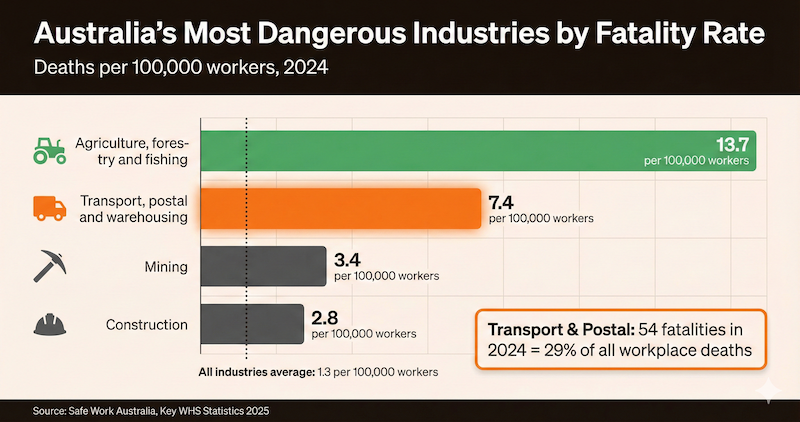
The transport, postal and warehousing sector recorded 54 worker fatalities in 2024 – that's 29% of all Australian workplace deaths, the highest proportion of any industry. The fatality rate of 7.4 deaths per 100,000 workers is nearly six times the national average of 1.3.[Safe Work Australia, Key Work Health and Safety Statistics Australia 2025]
This isn't for lack of trying. The sector logged 10,400 serious workers' compensation claims in 2023-24, with a frequency rate of 9.0 claims per million hours worked—well above the 6.8 national average. Average claim costs in Western Australia reached $82,145 per incident, compared to $64,738 across all industries.^[WorkCover WA, Industry Report: Transport, Postal and Warehousing 2024]
Safety teams have done what they were trained to do: more procedures, more training, more compliance documentation, more hazard reporting systems. Yet the numbers refuse to shift.
What's going on?
The ceiling nobody talks about
Safety performance in high-risk industries has hit what researchers call a "systemic ceiling" – not from lack of effort, but because conventional approaches have exhausted their effectiveness.
One analysis put it bluntly: traditional safety programs focus heavily on compliance rather than cultivating genuine cultural transformation. When enforcement and penalty models reach their limits, throwing more resources at the same methods yields diminishing returns.^[Tom Bourne, Why Today's Workplace Fatality Rates Have Reached a Plateau, 2024]
The fundamental engineering controls are already in place. Training programs exist. Hazard reporting systems capture incidents. Personal protective equipment is distributed. These are necessary foundations, but they're clearly not sufficient.
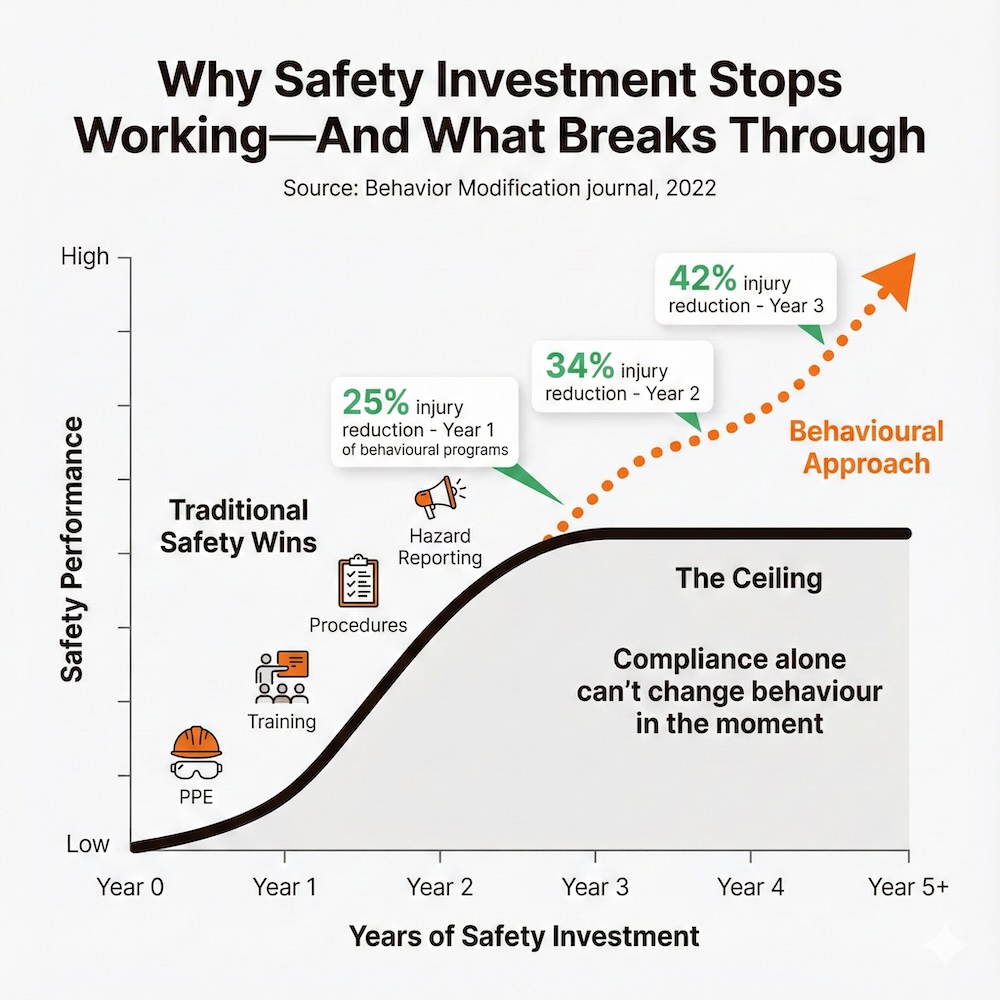
What remains are the thousands of micro-decisions workers make every shift: whether to take the shortcut, whether to report the near-miss, whether to lift properly when nobody's watching. Traditional safety systems address knowledge and detection. They don't address the gap between knowing what's safe and doing it consistently.
Where the injuries actually come from
Understanding what's hurting people reveals why procedural compliance can only take you so far.
Body stressing (manual handling) causes 39.9% of lost-time claims in the transport and postal sector: workers lifting, pushing, pulling, and bending their way through parcels, packages, and freight.^[WorkCover WA, Industry Report: Transport, Postal and Warehousing 2024] Nationally, one in four workplace injuries involves manual handling.^[Dorsavi, Reducing Musculoskeletal Injuries in Logistics and Distribution, 2024]
Falls, slips and trips account for 27% of claims. Same-level incidents – stumbling on a dock, slipping in a sorting facility, tripping over a parcel – make up the bulk of these.
Being hit by moving objects represents 16% of claims, including vehicle collisions and workers struck by equipment.^[Safe Work Australia, Key Work Health and Safety Statistics Australia 2025]
Every one of these injury types involves human behaviour in the moment. A worker decides how to lift a heavy parcel. A driver chooses whether to rush. A warehouse operator judges whether a path is clear enough.
You can train people on correct technique. You can post signage. You can discipline non-compliance after the fact. But none of that changes what happens in the split second before the injury occurs.
The science of what actually works
Here's where the research gets interesting, and points toward a fundamentally different approach.
Behaviour-based safety (BBS) and their evolved counterparts like Self Determination Theory (SDT) programs that emphasise positive reinforcement have demonstrated consistent results across industrial settings:
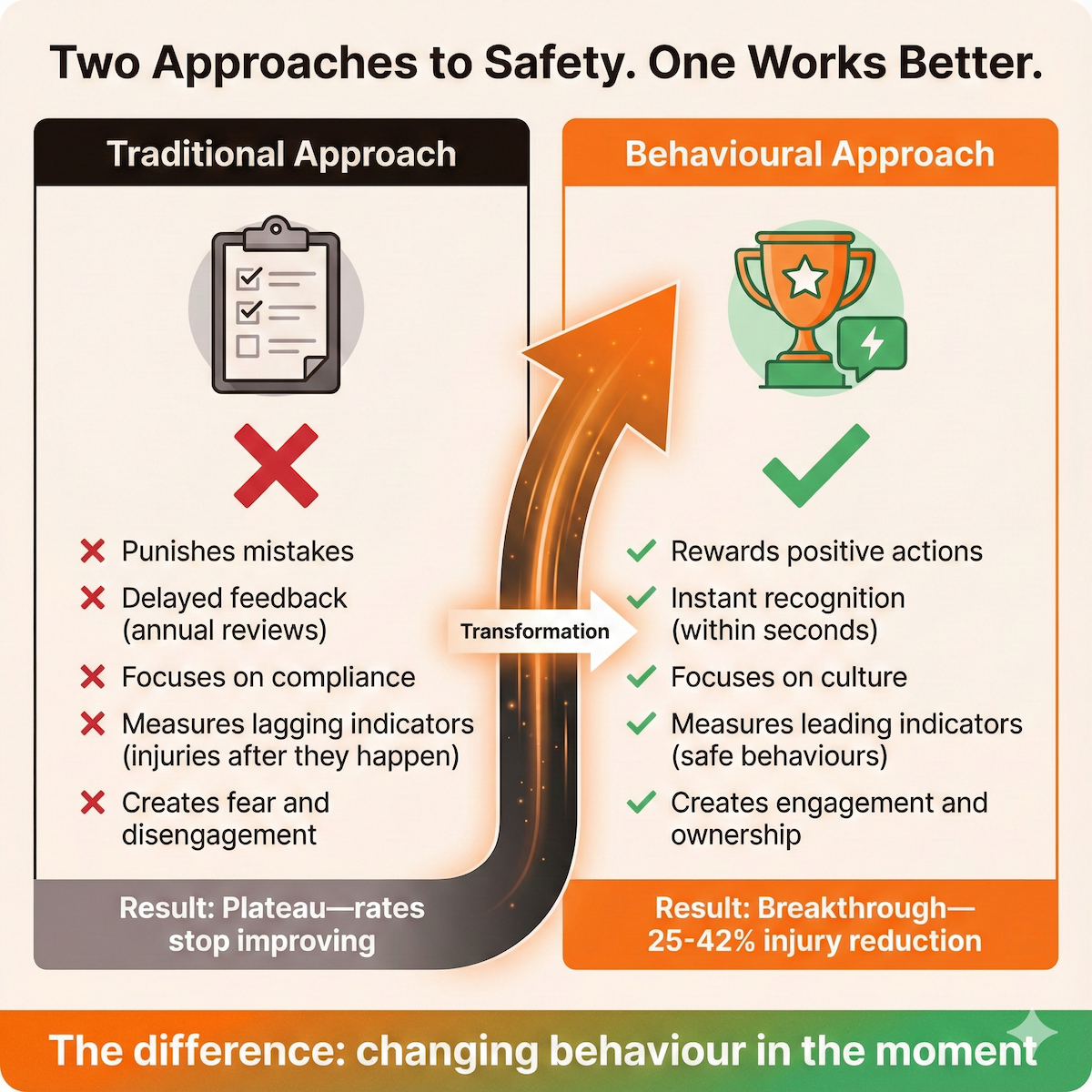
Source: Multiple peer-reviewed studies compiled in Behavior Modification journal, 2022^[Behavior Modification, Behavior-Based Safety Interventions, 2022]
One landmark study at a quarry site found lost work days decreased by 95% following BBS implementation. Construction site studies showed safety performance improvements from 86% to 92.9% within weeks of behavioural interventions.^[John Hopkins University, Behavioural Safety Interventions as a Component of Management]
The research consistently identifies what makes these programs work: active worker engagement (the more participation required, the greater the accident reduction), positive reinforcement (rewarding safe behaviour rather than only punishing unsafe acts), and critically, immediate recognition.
Neurological research confirms why timing matters. Dopamine release following recognition creates a reinforcement loop, making people more likely to repeat the behaviour that triggered the reward. This "feel-good" response forms positive connections between pleasure and safe actions.^[Bucket List Rewards, Psychology of Employee Recognition, 2024]
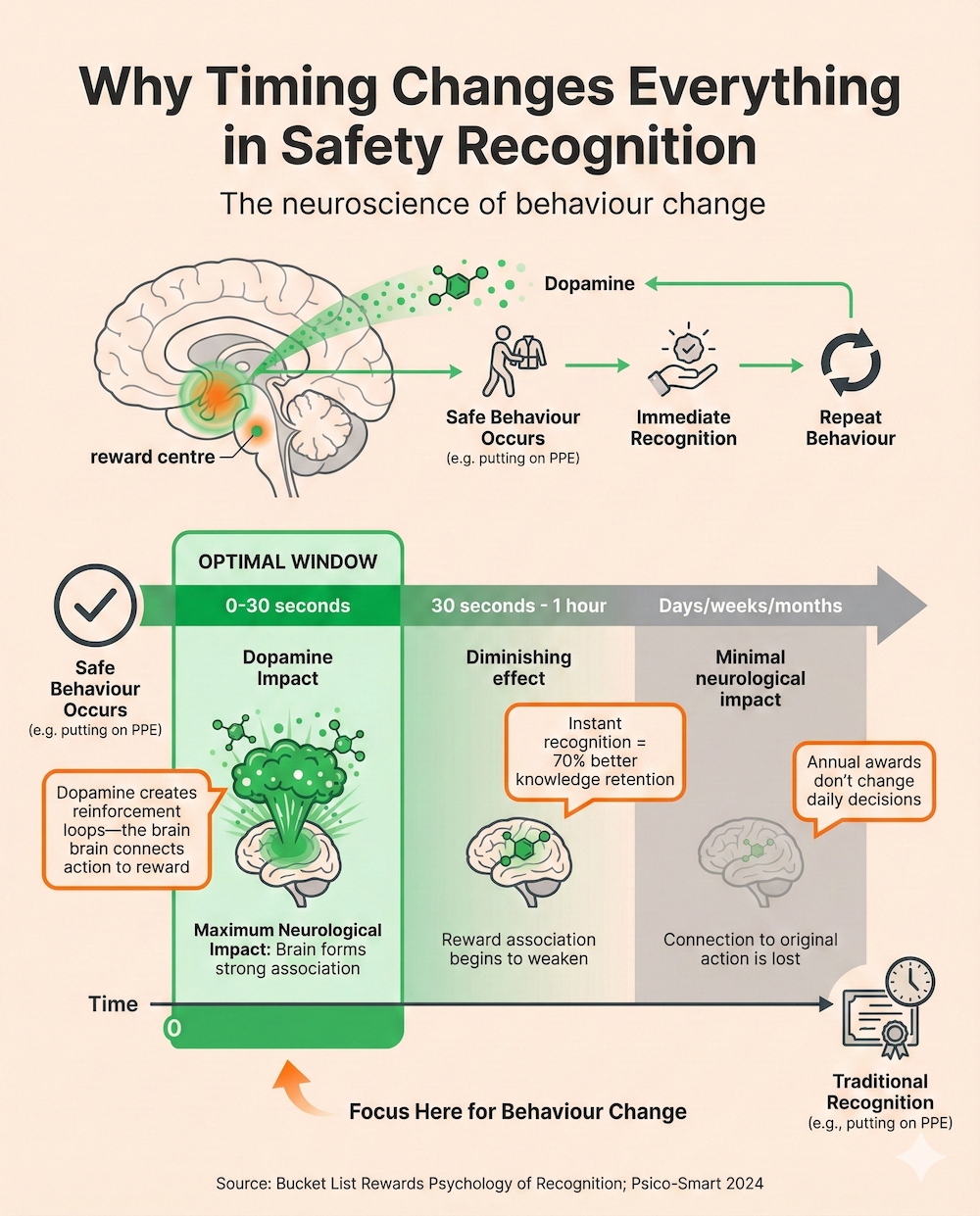
Delayed feedback – annual safety awards, quarterly reviews, end-of-project bonuses – simply doesn't create the same neurological effect. The brain has moved on.
Gamification: not a gimmick
When safety professionals hear "gamification," some roll their eyes. It sounds like turning serious business into a video game.
But the evidence is hard to dismiss:
- 30-47% increases in efficiency completing safety protocols^[Happily.ai, Using Gamification to Change Workplace Outcomes, 2024]
- 30-40% reductions in workplace incidents within the first year^[Psico-Smart, How Gamification Can Improve Compliance in Workplace Safety Training, 2024]
- 60% increases in engagement and up to 70% improvement in knowledge retention
The psychology behind these results isn't mysterious. Variable-ratio reward schedules – unpredictable yet dependable rewards – mirror what makes video games engaging. They maintain motivation without the extinction effect that comes from predictable incentives.^[Safety Talk Ideas, BBS Pitfalls: Positive Reinforcement, 2024]
This isn't about trivialising safety. It's about understanding what actually drives human behaviour and applying that knowledge to save people from injury.
The ROI question
For safety managers building a business case, the financial evidence is substantial.
A comprehensive systematic review of 141 workplace prevention interventions found 56.5% showed positive ROI, with only 8.7% showing negative returns.^[BMC Public Health, Systematic Review of Workplace Prevention ROI, 2023]
Psychology-based safety training programs have demonstrated returns ranging from 46% to 1,277%, depending on the intervention type and measurement period.^[Sentis, The Business Case for Safety, White Paper]

Source: Sentis White Paper, The Business Case for Safety
The broader research suggests an average return of $6 for every $1 invested in workplace safety programs.^[CBIZ, How Safety Programs Can Improve Your Bottom Line, 2024] Organisations with comprehensive safety incentive programs experienced a 44.2% reduction in mean lost time injuries.^[Murphy's Law, Work Safety Incentive Programs, 2024]
For context, Safe Work Australia estimates that eliminating work-related injuries and illnesses would deliver a $28.6 billion larger economy annually and 185,500 additional full-time equivalent jobs.^[AIHS, citing Safe Work Australia, Workplace Fatalities on the Rise, 2024]
The due diligence dimension
Beyond ROI, there's a personal accountability angle that senior leaders increasingly recognise.
Under Section 27 of the Work Health and Safety Act 2011, officers must exercise due diligence including acquiring WHS knowledge, understanding operational hazards, ensuring appropriate resources, and verifying compliance processes.
When injury rates plateau despite continued investment in traditional programs, the question becomes: what else should reasonably be tried?
Documented evidence of proactive cultural investment – including recognition systems that reinforce safe behaviour – demonstrates that leadership is doing more than the minimum. It shows genuine effort to move the needle when conventional approaches have stalled.
This isn't about legal cover. It's about the difference between compliance and leadership.
What a different approach looks like
Instant peer recognition for safety behaviours fills a specific gap that traditional systems can't address.
Instead of waiting for incidents to occur (and punishing them), supervisors and peers recognise positive actions in real time. A worker who stops to secure a load properly gets acknowledged immediately. Someone who spots and reports a hazard gets rewarded on the spot.
This creates three effects simultaneously:
- Neurological reinforcement — The brain connects the safe behaviour to a positive outcome while the memory is fresh
- Cultural signalling — Other workers see what "good" looks like, not just what "bad" leads to
- Data generation — Leading indicators (positive behaviours) become visible, not just lagging indicators (incidents after the fact)
The technology to enable this already exists. QR-code based recognition works on personal devices, requires no IT integration, and deploys in days rather than months.
The bottom line
The postal and logistics sector has a safety problem that more of the same won't solve. Traditional approaches have achieved what they can achieve. The remaining gains require addressing human behaviour in the moment—not through more procedures, but through immediate positive reinforcement.
The research supports it. The ROI justifies it. The due diligence case demands it.
The only question is how long organisations will continue investing in approaches that have plateaued while the injury numbers stay stubbornly high.
Scratchie is an instant recognition platform that helps organisations reinforce positive workplace behaviours. To see how it works in logistics and postal environments, book a demo.


%201%20(1).svg)


.svg)

